
The guitar may look mysterious at first, but once you understand how notes repeat and how the strings relate to each other, the entire fretboard starts to make sense.
Think of this post as your map of the guitar’s musical anatomy, a clear guide to how notes, strings, and patterns really work.
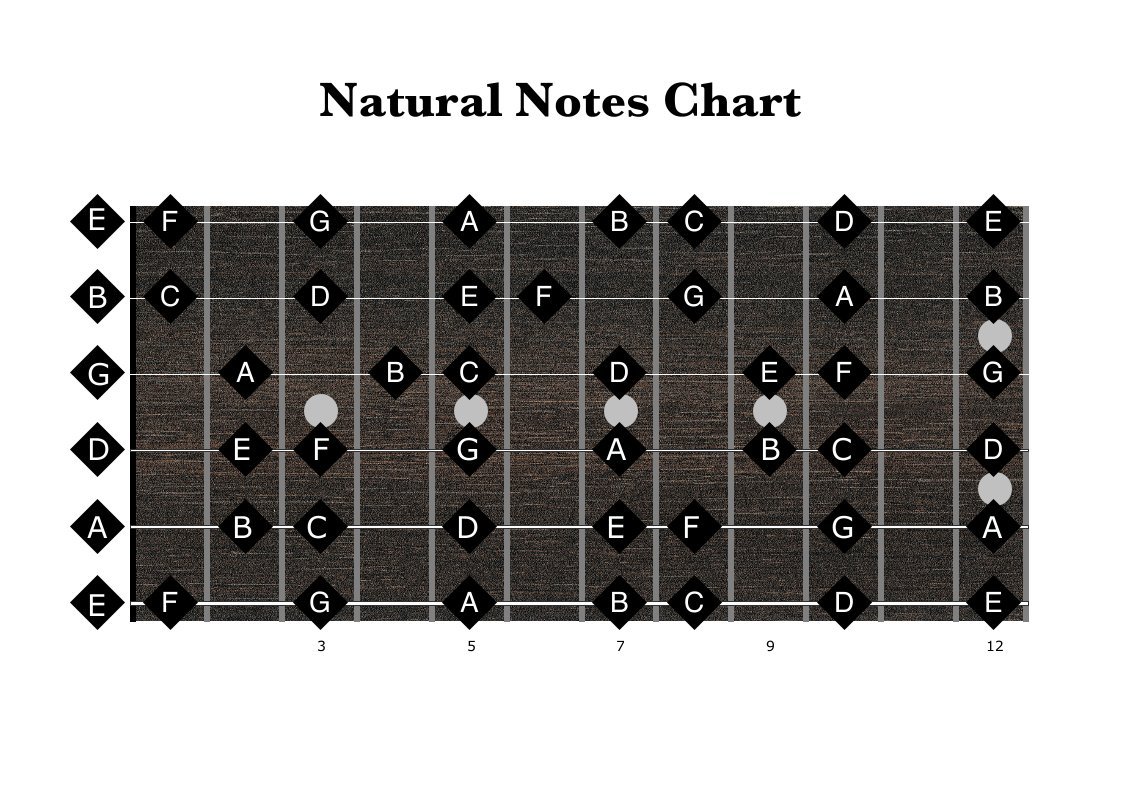
1. The Musical Alphabet on the Guitar
Music uses a simple 12-note alphabet. After the 12th note, everything repeats at a higher pitch.
A → A♯/B♭ → B → C → C♯/D♭ → D → D♯/E♭ → E → F → F♯/G♭ → G → G♯/A♭ → (back to A)
A few key things:
- There is no note between E–F and no note between B–C.
- Every fret on your guitar moves one step in this sequence.
- After 12 steps, the alphabet repeats.
This leads to one of the most important ideas in guitar anatomy:
2. The 12th Fret: The Reset Point
If you play any open string, then play the same string at the 12th fret, you are playing the same note, only one octave higher.
- Open string = E
- 12th fret = E (one octave above)
Why?
Because the 12th fret is exactly halfway along the string. When you cut a vibrating string in half, the pitch doubles, you hear the same note in a higher octave.
This applies to all strings.
3. Standard Tuning (and Why the B String Is Different)
A guitar in standard tuning is arranged like this:
E – A – D – G – B – E
Most strings are tuned a perfect fourth apart.
(a perfect fourth = 5 frets)
But G → B breaks the rule:
G → B = a major third (4 frets)
This one small difference is responsible for:
- the shape of open chords
- scale patterns “shifting” at the B string
- why barre chords are consistent but other shapes aren’t
It’s the reason the guitar sometimes feels “uneven.”
4. How Notes Repeat Across the Strings
Because of this tuning, notes line up in diagonal patterns.
Example:
If you play C on the A string, the same C appears on the D string two frets down and two strings up.
This kind of diagonal repetition is what gives the guitar its pattern-based nature.
If a note or shape works on one fret, it works everywhere (adjusting only for the B string).
5. Octave Shapes: Your Navigation System
Octaves are the fastest way to locate any note on the neck.
On guitar, there are three universal octave shapes.
Octave Shape 1 (E-shape)
- Start on the low E string
- Go two frets up, two strings down
→ You land on the same note, one octave higher.
Octave Shape 2 (A-shape)
- Start on the A string
- Go two frets up, two strings down
→ One octave above.
Octave Shape 3 (D-shape)
- Start on the D string
- Go two frets up, two strings down
→ Then move up 1 fret because of the B string.
Once you learn these three shapes, you can:
- find every note on the guitar in under a second
- see how chords are built
- understand scale positions
- navigate the entire neck visually
This is one of the biggest “aha!” moments for beginners.
6. Unison Shapes (Same Note, Same Pitch)
Besides octaves, the guitar also gives you unison notes, the same pitch played in a different position.
Examples:
- 5th fret E string = open A string
- 5th fret A string = open D string
- 5th fret D string = open G string
- 4th fret G string = open B
- 5th fret B string = open high E
These unisons are extremely useful for tuning by ear, but they also help you understand the geometry of the neck.
7. Why the Guitar Is a Pattern-Based Instrument
Because the musical alphabet repeats every 12 frets, and because the strings are mostly tuned in equal intervals, the guitar becomes a shape machine.
Once you learn:
- a chord shape
- a scale pattern
- an octave layout
…you can move it anywhere on the neck and it still works.
Think of guitar shapes like LEGO pieces:
once you know how they fit together, you can build anything.
Conclusion: Master the Logic, Not the Details
You don’t need to memorize the entire neck all at once, you just need to understand the logic behind it:
- the musical alphabet repeats
- the 12th fret is the reset point
- strings are mostly tuned in fourths (except B)
- notes repeat in predictable shapes
Once you internalize these simple principles, the fretboard becomes clear, intuitive, and creative, a tool you can express yourself with, not a puzzle to decode.